
- QSSHT Editorial Team
- November 2, 2026
Dump Trucks for Sale in Qatar: Choosing the Right Configuration for Construction
When searching for a dump truck for sale in Qatar, choose the configuration by its intended material, route, site conditions, loading method, and operating cycle—not by headline payload or body volume alone. A truck that performs well on paved routes may not be the right choice for loose construction surfaces, restricted sites, quarry work, or repeated short-haul tipping.
Qatar-based contractors, procurement teams, owner-operators, and fleet managers should compare the complete vehicle: chassis, axle configuration, powertrain, tipper body, hydraulics, tyres, braking systems, and local support. Manufacturer ratings must also be considered separately from Qatar’s applicable registration, axle-load, and operating limits, which should be confirmed before purchase.
What to Check Before Buying a Dump Truck in Qatar
A productive buying process begins with an operating brief. Without one, suppliers may quote different chassis, bodies, tyres, warranties, or equipment packages that cannot be compared fairly.
1. Define the material
Identify whether the truck will carry sand, aggregate, excavated soil, demolition waste, general construction spoil, or quarry material. Material density is critical because payload and body volume are not the same. Two trucks with bodies of similar volume can reach very different operating weights when loaded with different materials.
Loose, low-density material may fill the body before the truck reaches its permitted weight. Dense aggregate or rock may reach a weight limit while part of the body remains empty. Ask the body supplier to calculate the proposed body around the actual material rather than assuming that the largest body is automatically the most productive.
2. Map the complete route
Record the percentage of travel on public roads, prepared access roads, construction sites, and loose or uneven ground. Also note gradients, turning areas, entry restrictions, loading points, tipping locations, and trip length.
A truck operating mainly between a construction site and a disposal facility has different requirements from a unit that remains inside a quarry or controlled project area. The route affects axle selection, gearing, tyre choice, traction requirements, manoeuvrability, fuel use, and driver workload.
3. Confirm applicable weight and registration requirements
Manufacturer-rated gross vehicle weight, axle capacities, and body specifications do not by themselves establish the legal load on Qatar roads. Before signing an order, obtain written confirmation of the relevant registration, homologation, dimensions, axle loads, and permitted operating weight from current local sources.
The practical operating limit may be determined by the lowest applicable restriction among the chassis rating, body approval, tyres, axles, hydraulic installation, and legal requirements. Do not calculate expected productivity using only a brochure’s maximum figure.
4. Describe the loading and tipping cycle
Specify whether the truck will be loaded by an excavator, wheel loader, conveyor, or another method. The loading equipment influences body height, side-wall protection, impact loading, and the risk of accidental overloading. Buyers should also document the expected trips per shift, idling time, average loaded distance, and frequency of tipping.
Is a 6×4 Dump Truck Right for Your Construction Work?
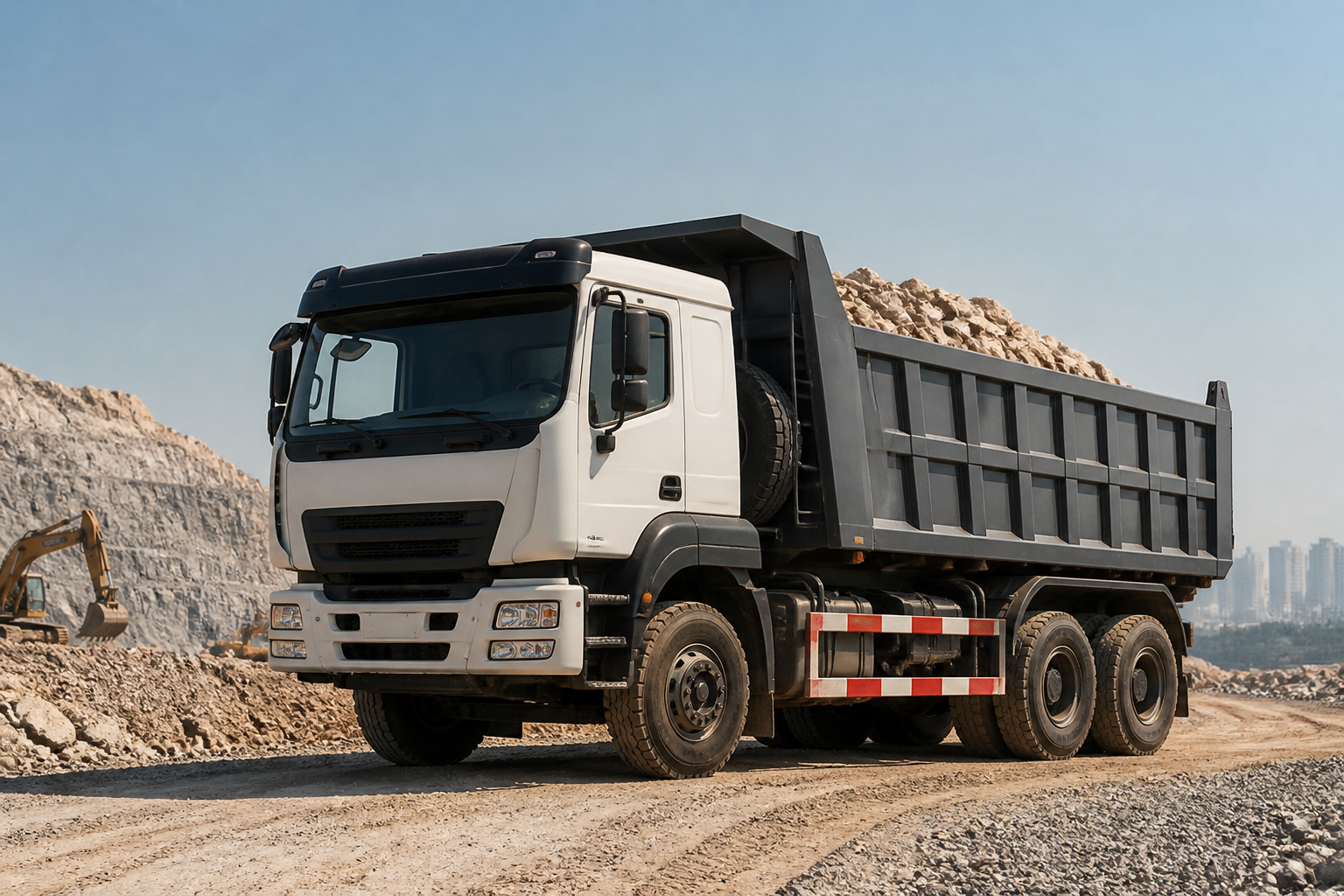
A 6×4 dump truck generally has three axle positions, with two axle positions driven. This layout is one important option for construction fleets because it can be evaluated for a combination of road travel, load carrying, and traction. However, a 6×4 dump truck in Qatar is not automatically the correct choice for every contract.
The decision should be based on the completed truck and its duty cycle. Important questions include:
- How much of each journey is on public roads?
- Will the truck regularly cross loose sand, mud, rubble, or uneven site surfaces?
- How much turning space is available at loading and tipping points?
- What material will be carried, and how dense is it?
- What are the manufacturer-rated and locally permitted axle loads?
- How much weight will the body, hydraulic gear, fuel, driver, and installed equipment add?
- Are suitable tyres, axle components, and driveline parts available locally?
More driven axles can support traction in difficult conditions, but the complete driveline may also affect vehicle weight, maintenance requirements, tyre costs, and fuel use. A higher axle-count rigid truck may offer a different distribution of load, while a lighter layout may be more manoeuvrable or economical in less demanding work. Neither conclusion should be assumed without route and load data.
| Configuration to investigate | Operating questions | Potential advantages to assess | Trade-offs to verify |
|---|---|---|---|
| Lighter rigid tipper layout | Is the work road-biased, space-restricted, or based on lighter loads? | Manoeuvrability, lower chassis weight, and operating simplicity | Traction, axle loading, payload, and site suitability |
| 6×4 rigid tipper | Does the route combine road travel with construction-site operation? | Balance of road use, driven-axle traction, and rigid-truck practicality | Legal weight, tyre cost, turning space, gearing, and body weight |
| Higher axle-count rigid tipper | Do the intended load and applicable limits justify the additional axle position? | Alternative load distribution and body options | Longer chassis, manoeuvrability, tyre count, purchase cost, and availability |
| Off-highway or articulated dump truck | Will the vehicle remain primarily on a controlled site with difficult terrain? | Purpose-designed site mobility and heavy-duty operation | Road legality, transport between sites, acquisition cost, and specialised support |
This is a selection framework, not a statement that every configuration is currently offered by QSSHT or a particular manufacturer in Qatar.
Road-Going Tipper, Articulated Truck, or Off-Highway Dump Truck?
“Dump truck” and “tipper truck” are often used as related search terms, but they do not always describe equivalent vehicles. Buyers should identify the required category before requesting quotations.
Road-going rigid tipper
A rigid tipper combines a commercial-vehicle chassis with a tipping body. It may be appropriate where the operating cycle includes public roads and construction sites. The chassis, body, subframe, hydraulic equipment, and axle loading must be engineered and approved as one completed vehicle.
When searching for a tipper truck in Qatar, ask whether the quotation includes the body and tipping system or only the chassis. Also confirm who is responsible for body installation, final approval, warranty coordination, and aftersales support.
Off-highway rigid dump truck
An off-highway rigid dump truck is intended principally for controlled sites such as large earthmoving, mining, or quarry operations. It should not be treated as a direct substitute for a road-going 6×4 commercial vehicle merely because both transport and discharge material.
Articulated dump truck
An articulated dump truck uses an articulated chassis arrangement designed for demanding site mobility. Its operating profile, service needs, transport requirements, and purchase case differ from those of a road-going rigid tipper.
The distinction also changes the support network a buyer should investigate. For example, Al-Bahar’s official Qatar location page lists new, rental, used, parts, and service activities associated with Cat equipment. That supports the importance of local equipment support, but it does not confirm that a specific Cat dump-truck model is currently available or that it is equivalent to a road-going rigid tipper.
Matching the Material, Tipper Body, and Chassis
The tipper body is part of the working vehicle, not an accessory to select after the chassis order. An unsuitable body can add unnecessary weight, create poor load distribution, reduce productivity, or expose the chassis and hydraulic system to demands they were not designed to handle.
Body geometry and construction
Ask the supplier and body builder to explain the proposed body geometry, floor construction, side material, wear protection, tailgate arrangement, and reinforcement. Rock or demolition work may impose different impact and abrasion demands from sand or general spoil.
More steel and reinforcement may improve durability for a severe application, but it also adds tare weight. That can reduce the load available within the applicable vehicle and axle limits. The correct balance depends on the material, loading equipment, cycle frequency, and expected service life.
Tailgate and discharge arrangement
The tailgate should suit the material and discharge method. Buyers should check how it opens, locks, and behaves when material is wet, compacted, or unevenly loaded. The supplier should identify maintenance points and confirm how replacement components will be obtained.
Hydraulic tipping system
Request the make and model of the hydraulic components, their rated application, maintenance requirements, operating instructions, and parts source. The proposal should explain the power take-off, pump, cylinder, controls, hydraulic reservoir, hoses, protection, and installation responsibility.
Do not accept an assumed tipping angle or tipping time. These should be documented for the exact completed vehicle if they are important to the operation.
Chassis and body compatibility
Obtain written confirmation that the chassis manufacturer or authorised technical channel accepts the proposed body installation. The body builder should provide an axle-load calculation for both empty and loaded conditions, using the intended material and realistic load placement.
The proposal should clearly identify which party warrants the chassis, body, hydraulics, subframe, and installation. It should also explain how a problem involving more than one supplier will be handled.
Powertrain, Traction, Braking, and Tipping Safety
A dump truck’s engine rating is only one part of performance. The engine, transmission, final-drive ratio, driven axles, suspension, tyres, and braking systems must work together across the planned route.
Powertrain and gearing
Compare engine output and torque characteristics only at exact variant level. Then assess transmission ratios and final-drive gearing against loaded gradients, average road speed, site movement, and trip distance. A specification designed for slow, demanding site work may behave differently from one selected for longer road journeys.
Ask how the cooling and filtration package is specified for the expected heat, dust, idling, and loading conditions. Request maintenance instructions for radiators, air filters, fuel filtration, and other components affected by the operating environment.
Tyres, suspension, and traction
Tyres must have the correct size, pattern, and load rating for the completed truck. Check whether the proposed tread suits the road-to-site mix and whether replacement tyres are readily obtainable. A tyre that performs well on prepared roads may not provide the same result on loose construction surfaces.
Tyre cost should be considered at fleet level. Record replacement frequency, damage, rotations, pressure checks, and failures by vehicle and route. This creates better evidence for future purchasing than relying on a general fuel or tyre claim.
Braking and driver control
Request details of the service brakes, parking brake, available auxiliary braking systems, and any model-specific safety equipment. The required specification depends on loaded weight, gradients, road speeds, and operating cycle. Drivers should be trained for the exact truck, controls, body, and tipping procedure.
Safe tipping conditions
Tipping stability depends on the vehicle, load distribution, body design, ground condition, and operating procedure. The truck should be positioned on suitable ground, with adequate overhead and surrounding clearance. Operators should follow the manufacturer’s instructions and site rules, prevent unauthorised entry into the operating area, and stop if the load does not discharge normally.
Buyers should ask for documented operator training, body inspection points, hydraulic-system checks, and maintenance procedures. Safety must be assessed for the completed vehicle rather than the bare chassis alone.
Aftersales Support and Total Ownership Cost
The lowest purchase quotation may not produce the lowest cost per trip. A commercial comparison should include fuel, tyres, scheduled maintenance, hydraulic repairs, parts supply, workshop access, driver training, downtime, and eventual disposal or resale.
Evaluate support for the exact model
A supplier’s general presence is not enough. Confirm support for the precise chassis variant, engine, transmission, axles, electronics, body, and hydraulic system being quoted. Ask for workshop locations, field-support arrangements, parts ordering procedures, diagnostic capability, and escalation contacts.
Warranty terms should be provided in writing. Review the duration, usage limits, exclusions, maintenance conditions, geographic coverage, and responsibility for body-related failures. Do not assume that chassis and body warranties have the same terms.
Calculate cost from the real duty cycle
A useful internal cost model can include:
- Vehicle, body, hydraulic equipment, and optional-equipment purchase cost
- Registration, insurance, and financing costs where applicable
- Fuel use measured on the intended route
- Tyres and tyre-related downtime
- Preventive maintenance and replacement parts
- Body and hydraulic-system maintenance
- Driver and operator training
- Planned utilisation and expected working life
- Lost revenue or replacement-hire cost during downtime
- Expected disposal or resale outcome, without treating it as guaranteed
Compare cost per trip or cost per tonne only after confirming the truck’s lawful and technically approved working load. Hypothetical payload figures can make a poor configuration appear more profitable than it will be in operation.
Evaluating FAW and Other Dump-Truck Proposals
FAW is relevant to buyers researching a FAW dump truck in Qatar because the manufacturer has published a specification for a J6P 6×4 dump-truck family. The FAW Trucks global J6P 6×4 technical document includes multiple CA-series variants and corresponding cab, engine, and transmission information.
However, this global document is not proof that every listed variant is currently available, homologated, stocked, or supported in Qatar. Its URL also contains a 2021 date path, so buyers considering a November 2026 purchase should request a current, dated Qatar-market quotation and model-specific build sheet.
Never combine an engine from one PDF row with a transmission, axle rating, or chassis detail from another. Record the complete model and variant code, then compare every value against that exact row. Local availability, warranty, body installation, delivery timing, and regulatory approval should be confirmed separately in writing.
For broader background, readers can review FAW truck configurations in Qatar and QSSHT’s overview of FAW Trucks in the global heavy-truck context. QSSHT also provides wider context on heavy trucks in Qatar. These pages provide background rather than confirmation of current dump-truck inventory or a specific commercial offer.
Use a written comparison sheet
| Item to compare | Information to request | Why it matters |
|---|---|---|
| Exact vehicle identity | Model, variant code, model year, and dated specification | Prevents specifications from different variants being mixed |
| Rated and legal weights | Manufacturer ratings plus current Qatar regulatory confirmation | Establishes the applicable operating limit |
| Axle and driveline layout | Axle ratings, driven axles, gearing, and differential equipment | Connects traction and load distribution to the duty cycle |
| Body proposal | Body builder, materials, dimensions, tare weight, and axle-load calculation | Confirms suitability for the intended material |
| Hydraulic equipment | Component identities, ratings, parts source, and warranty | Clarifies maintenance and installation responsibility |
| Tyres and brakes | Exact tyre specification and braking-system details | Supports load, route, traction, and safety assessment |
| Support package | Warranty, service plan, workshop capability, field support, and parts process | Helps estimate downtime exposure |
| Commercial offer | Price, exclusions, delivery estimate, payment terms, and offer validity | Allows a fair like-for-like comparison |
Final buying checklist
- Define the material, density range, loading method, and trips per shift.
- Map road, site, gradient, surface, and turning conditions.
- Confirm the exact chassis and axle configuration.
- Obtain manufacturer-rated weights and current local regulatory confirmation.
- Request a body drawing and loaded axle-weight calculation.
- Verify chassis approval for the body and hydraulic installation.
- Check tyres, braking systems, cooling, and filtration.
- Review parts availability and workshop capability for the exact variant.
- Read all chassis, body, hydraulic, and service warranty terms.
- Calculate expected cost per trip using realistic utilisation and downtime.
- Obtain written confirmation of availability, delivery, and commercial exclusions.
Frequently Asked Questions
Is a 6×4 dump truck always the best choice for construction in Qatar?
No. A 6×4 can be evaluated for mixed road and construction-site work, but suitability depends on material, route, traction, turning space, weight limits, body design, and operating cost. Other rigid or off-highway configurations may be more appropriate for particular duties.
What is the difference between payload and body volume?
Payload describes the load weight the completed vehicle can carry within all technical and legal limits. Body volume describes the space available for material. Because sand, aggregate, rock, and demolition waste have different densities, the same body volume can produce very different loaded weights.
Can a global FAW J6P specification be used to order a Qatar truck?
It can help identify the documented vehicle family and available global variants, but it should not be treated as a current Qatar order sheet. Request the exact variant code, current local specification, regulatory confirmation, body proposal, warranty, availability, and delivery terms in writing.
Should the chassis and tipper body be purchased separately?
They may be supplied by different parties, but they must be assessed as one completed vehicle. Confirm chassis approval, subframe design, axle loads, hydraulic compatibility, warranties, and responsibility for resolving installation-related problems.
What should a dump-truck quotation include?
It should identify the precise chassis variant, body, hydraulics, tyres, optional equipment, rated weights, warranty, service support, price, exclusions, offer validity, and estimated delivery. It should also state which regulatory approvals or registration steps remain the buyer’s responsibility.
How should buyers compare dump-truck ownership costs?
Compare acquisition cost together with fuel, tyres, preventive maintenance, hydraulic repairs, parts, workshop access, downtime, training, financing where applicable, and expected disposal value. Use route and load data from the intended operation rather than generic savings claims.
Choosing a Dump Truck for Qatar Construction
The right dump truck for sale in Qatar is the one configured for a clearly defined duty cycle and supported by model-specific documentation. Begin with the material and route, then evaluate axle layout, driven axles, chassis ratings, body design, hydraulics, tyres, braking, support, and ownership cost.
A FAW J6P 6×4 specification provides a useful reference point for buyers investigating a FAW dump truck in Qatar, but current Qatar availability and the exact local configuration must be confirmed. Use a dated quotation, complete build sheet, axle-load calculation, written warranty, and current regulatory checks before making a commercial decision.
When requesting information from QSSHT or any prospective supplier, provide a detailed operating brief and ask for a complete chassis-and-body proposal. That approach makes quotations easier to compare and reduces the risk of selecting a tipper truck that looks suitable on paper but does not match the construction work it must perform.