
- QSSHT Editorial Team
- November 2, 2026
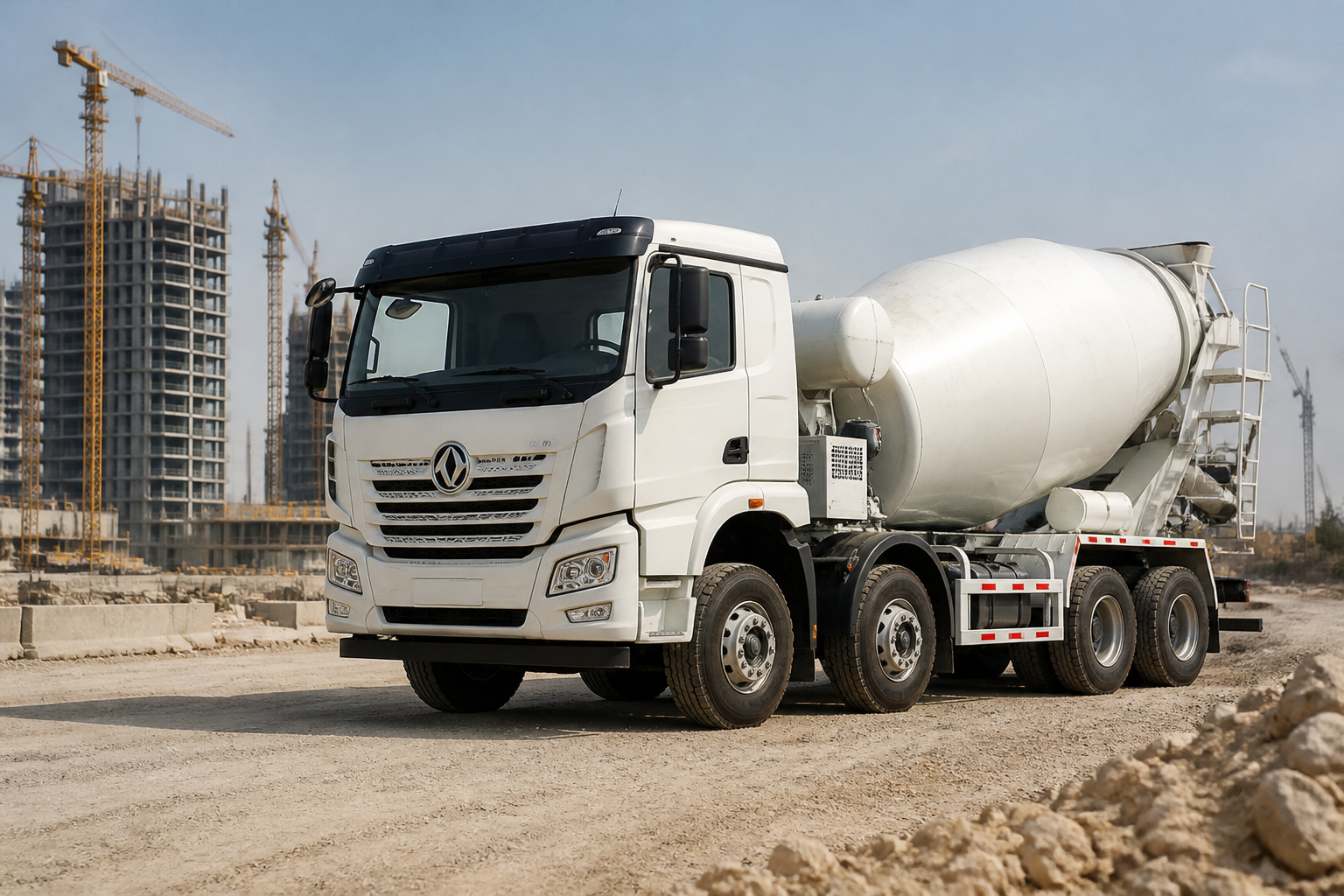
Concrete Mixer Trucks in Qatar: What Ready-Mix Operators Should Specify
A concrete mixer truck for Qatar should be specified as a completed working vehicle, not selected by advertised drum size alone. Ready-mix operators need to compare the legal payload, individual axle loads, chassis configuration, mixer body, hydraulic drive, cooling performance, safety equipment, local support and warranty responsibility under their actual delivery cycle.
Before ordering, require each supplier to provide a completed-vehicle specification and axle-load calculation that includes the chassis, mixer assembly, fuel, driver, water, tools and installed options. Current weight and transport requirements should be confirmed through the Qatar Ministry of Transport’s official land-transport publications and any other competent authority. This approach allows buyers to compare proposals on usable, legally transportable concrete capacity rather than headline drum volume.
1. Specify the Complete Mixer Truck, Not Just the Drum
A truck-mounted concrete mixer consists of two major packages: the heavy-truck chassis and the mixer body installed on it. Those components may come from different manufacturers and may be supplied, installed or supported by different companies. A quotation for a concrete mixer truck in Qatar should identify every party involved.
The chassis must be suitable for the mixer installation, its load distribution and the intended operating environment. The body builder must also follow the chassis manufacturer’s mounting requirements. The existence of a heavy-duty chassis in a supplier’s range does not establish that it is approved for a mixer body.
Clarify chassis-body responsibility
Ask the bidder to state:
- Who manufactures and supplies the chassis.
- Who manufactures the drum, subframe, drive system and discharge equipment.
- Who installs and commissions the mixer assembly.
- Whether the installation has chassis-manufacturer or body-mounting approval.
- Who warrants the chassis, mixer equipment and chassis-body interface.
- Whether one company coordinates the complete-vehicle warranty.
- Which workshop handles hydraulic, drum-drive and chassis faults.
This division of responsibility matters when a fault involves more than one system. For example, a PTO, hydraulic pump or mounting issue could require input from both the chassis provider and the mixer-body supplier. A single point of contact can simplify support, but that responsibility should be written into the contract rather than assumed.
Operators comparing other vocational vehicles may also find the same duty-led approach in QSSHT’s guide to choosing the right construction truck configuration. Mixer trucks have different body and payload requirements, but both categories must be matched to axle loading, routes and site access.
2. Calculate Legal Payload and Individual Axle Loads
Advertised drum capacity is not the same as legal concrete payload. A large geometric drum may be mounted on a completed truck that cannot legally carry a corresponding concrete load once every component and operating item is counted.
Buyers should begin with the chassis tare weight, then add the mixer body, mounting structure, hydraulic equipment, chute extensions, water system, fuel, driver, tools, safety equipment and optional accessories. The remaining permissible load must also be distributed within the applicable limits for each axle—not merely kept below a stated gross vehicle weight.
Ask suppliers to define every capacity term
Mixer quotations may use similar-looking terms differently. Require a written definition of:
- Geometric drum volume: the drum’s physical internal volume.
- Rated mixing capacity: the quantity the equipment is designed to mix under stated conditions.
- Agitating or transport capacity: the quantity intended to be transported while the drum agitates it.
- Completed-vehicle legal payload: the permissible carried load after accounting for the vehicle’s operating weight.
- Residual-load assumption: any concrete expected to remain in the drum after discharge.
- Water allowance: whether a full water tank is included in the weight calculation.
| Quotation item | Why it is insufficient alone | What the buyer should request |
|---|---|---|
| Drum volume | Does not establish legal carrying capacity | Defined mixing and transport capacities plus legal payload |
| Gross vehicle weight | Does not show whether an individual axle is overloaded | Loaded and unladen axle-load calculations |
| Chassis tare weight | Excludes the mixer body and operational equipment | Completed-vehicle tare estimate and final certificate |
| Nominal concrete capacity | May rely on unstated material or operating assumptions | Calculation method and all weight assumptions |
| Water-tank capacity | Water reduces available payload when carried | Weight calculation with the tank full |
Do not rely on a generic regional limit or a figure carried over from an older tender. Qatar’s current gross-weight, axle-load, dimensional, registration and permit requirements should be checked against official documentation for the proposed configuration at the time of purchase.
3. Match the Chassis to the Delivery Cycle
The best chassis depends on how the ready-mix fleet actually works. Fleet managers should provide bidders with an operating profile instead of asking for a general-purpose mixer truck.
Document the route and site profile
The supplier should know the typical plant-to-site distance, number of trips per shift, daily operating hours and likely queuing time. The specification should also describe urban traffic, low-speed maneuvering, construction-site surfaces, gradients, restricted entrances and the frequency of reversing.
These factors influence axle configuration, driven-axle arrangement, wheelbase, gearing, cooling, traction, turning requirements, tire wear and fuel use. They also affect the required discharge performance and the time the drum and hydraulic system operate during each trip.
Useful operating data includes:
- Average and maximum delivery distance.
- Expected trips and operating hours per shift.
- Typical idling and site-waiting time.
- Urban-road versus unpaved-site operation.
- Maximum expected gradients and poor-surface conditions.
- Access restrictions and low-speed turning requirements.
- Required discharge rate and chute reach.
- Frequency of residual concrete returning to the plant.
Compare axle arrangements using completed-vehicle data
More axles do not automatically make a proposal better. The correct arrangement depends on legal weight distribution, payload, maneuverability, traction and site conditions. Ask for turning information, axle ratings and both laden and unladen load distribution for the exact wheelbase and mixer installation.
Transmission and driveline selection should likewise reflect stop-start deliveries, low-speed site work and the need to operate the mixer drive. Any performance claim should relate to the exact chassis, gearing, tires and completed vehicle—not a different model from a general truck brochure.
4. Define the Mixer Body, Drive, Water System and Chute
Once the chassis and payload are established, the operator can define how the mixer body must perform. Suppliers should provide model-specific documentation rather than broad claims about durability or mixing quality.
Drum and wear components
Request the drum and blade material specification, published wear-protection features, inspection access and replacement procedure. The proposal should identify the availability of blades, liners where fitted, drum rollers and other wear items. No material should be assumed to deliver a fixed service life because wear varies with concrete mix, cleaning, operating hours and maintenance.
PTO and hydraulic drive
The power take-off and hydraulic package must be compatible with the chassis and mixer. The quotation should identify the PTO type, hydraulic pump and motor manufacturers, control arrangement and supported operating procedures.
Ask whether drum-speed and direction controls are available from both the cab and rear operating station. Clarify emergency controls, protection against unintended operation and the manual recovery procedure following an engine or hydraulic failure. Parts availability for pumps, motors, valves, hoses and seals should be confirmed separately from normal chassis parts support.
Chute and discharge equipment
Specify the required chute arrangement, reach and extension storage. Compare manual and powered movement, transport locks, work lighting, rear visibility and the accessibility of operating controls. Chutes and extensions must be secured for road travel and manageable at the types of delivery sites the fleet serves.
Water and wash-down equipment
The RFQ should state the water-tank capacity, tank material, level indication, pressurization method, hose arrangement and wash-down points. The supplier should show the effect of a full tank on completed-vehicle weight and axle distribution.
Operators should separately confirm project, municipal and environmental requirements governing concrete residue and wash water. A truck’s wash-down equipment does not by itself establish where residue may be discharged.
5. Prepare the Truck for Qatar Operating Conditions
Heat, dust, prolonged idling and low-speed work can place significant demands on a mixer truck. Instead of accepting a generic statement that a vehicle is suitable for hot climates, buyers should request documented performance for the exact chassis and mixer configuration.
Cooling and filtration questions
- How is engine and transmission cooling managed during idling and low-speed operation?
- What cooling equipment is fitted to the hydraulic system, if required?
- Can radiators and coolers be inspected and cleaned without excessive dismantling?
- What air-filtration system is fitted, and what are its inspection intervals?
- Are hydraulic and electrical connections protected for dusty site operation?
- Which lubricants, filters, hoses and seals are approved and stocked locally?
- What air-conditioning performance and maintenance provisions apply to the cab?
Avoid inserting an assumed ambient-temperature rating into a tender. Require the chassis and mixer manufacturers to state the published operating conditions for the exact equipment offered. If additional cooling or filtration is proposed, ask whether it is factory approved and included in warranty coverage.
Maintenance access affects uptime
Daily cleaning and inspection points should be accessible without encouraging unsafe climbing. Buyers should inspect access to the radiator, air filters, hydraulic reservoir, drum rollers, grease points, chute pivots, control stations and electrical connectors.
The operator should also define a lockout procedure for drum inspection and maintenance. Safe ladders, platforms and handholds are valuable only when their use is supported by documented operating and maintenance procedures.
6. Evaluate Safety, Local Support and Total Ownership Cost
For a ready-mix fleet, an unavailable truck can disrupt dispatch planning and concrete deliveries. Purchase price is therefore only one part of the commercial comparison. Buyers should evaluate preventive maintenance, service coverage, parts lead times, cleaning requirements and the cost of downtime.
Recommended safety and visibility features
Depending on the operator’s risk assessment and applicable Qatar requirements, the specification may include a reversing camera, audible warning, proximity or blind-spot aids, rear work lights, high-visibility markings, chute transport locks and safe cab access. Side protection, rear underrun equipment, interlocks and other equipment should be checked against current legal and registration requirements.
The tender should clearly distinguish between equipment required by law and additional fleet-safety features. Do not label a feature mandatory without confirmation from the competent authority.
Investigate support before choosing a supplier
A prospective mixer truck supplier in Qatar should be asked to document:
- Local workshop locations and available working hours.
- Mobile-service capability and any contractual response commitment.
- Diagnostic coverage for the chassis and mixer controls.
- Hydraulic-system and drum-drive expertise.
- Local stock of scheduled-service and high-wear parts.
- Expected lead times for gearboxes, pumps, motors, rollers and control components.
- Driver, operator and technician training.
- Warranty exclusions involving overloading, buildup, cleaning or body installation.
Verified official channels can be useful starting points, but availability must still be confirmed. QFAB’s official Qatar page lists a Liebherr truck mixer within its concrete-equipment offering. That page does not by itself confirm current models, chassis pairings, inventory, prices, lead times or warranty terms.
For chassis enquiries, Scania’s official website identifies Arabian Agencies Company as an authorized dealer serving Qatar. This verifies a truck sales and support channel, but it does not establish that a particular Scania chassis is approved, stocked or offered as a complete mixer truck. Model suitability must be confirmed in writing.
Compare cost per productive delivery
A total-cost review can include purchase price, finance, scheduled servicing, tires, fuel, hydraulic maintenance, drum wear, cleaning labor, parts, downtime and resale expectations. Fuel or cost-per-cubic-metre claims are meaningful only when proposals use comparable routes, payloads, traffic, idling time and delivery volumes.
Fleet standardization may simplify parts, diagnostics and training, while a mixed fleet can widen procurement options. Operators should model both choices using their own maintenance and utilization data rather than assuming either strategy is always cheaper.
When considering a used cement mixer truck for sale in Qatar, request chassis and mixer service histories, operating hours where recorded, previous axle-weight documentation, hydraulic test results and evidence of drum repairs. Inspect for concrete buildup, drum and blade wear, roller condition, hydraulic leakage, subframe damage, unauthorized modifications and corrosion around mounting points.
7. Use a Structured RFQ and Completed-Vehicle Acceptance Process
A common request-for-quotation format prevents suppliers from presenting unlike specifications under similar headline descriptions. Require every bidder to complete the same schedule and identify any exceptions.
| RFQ category | Required information |
|---|---|
| Chassis | Exact model, axle arrangement, wheelbase, driveline, tires and body-mounting approval |
| Weight | Chassis tare, completed tare, gross operating weight and individual laden axle loads |
| Payload | Legal concrete payload with fuel, driver, full water tank, tools and options included |
| Mixer body | Manufacturer, model, capacity definitions, drum materials and wear features |
| Drive system | PTO, pump, motor, controls, emergency procedure and replacement-parts support |
| Discharge | Chute configuration, reach, extensions, controls, locks and published discharge data |
| Support | Maintenance intervals, workshop responsibility, parts availability and training |
| Warranty | Separate chassis and mixer terms plus responsibility for the interface |
| Compliance | Applicable Qatar registration, homologation and transport documentation |
Inspect and test before final acceptance
At delivery, compare the truck with the contracted specification rather than accepting it from appearance alone. Record identifying numbers for the chassis and major mixer components, inspect mounting points and verify installed options.
The acceptance procedure should include:
- A final tare-weight certificate or other required weight documentation.
- Confirmation of loaded axle calculations and legal payload.
- Inspection for hydraulic leaks and damaged hoses or connections.
- Drum rotation and control tests from every operating station.
- A discharge and chute-operation test.
- Checks of cameras, warnings, lights, locks and emergency controls.
- Verification of any onboard water or metering equipment.
- Delivery of parts lists, maintenance manuals and warranty documents.
- Completion of driver and technician training.
- Written local service contacts for both chassis and mixer systems.
Any payload, compliance or installation condition should be resolved before the truck enters service. Verbal assurances about future approval, parts support or warranty coordination are not substitutes for contract documents.
Frequently Asked Questions
What is the most important specification for a concrete mixer truck in Qatar?
The starting point is the completed vehicle’s legal payload and individual axle-load distribution. Drum volume alone cannot show how much concrete the truck may legally carry. The calculation should include the body, fuel, driver, water, tools and all installed options.
Are “cement mixer truck” and “concrete mixer truck” the same?
The phrases are often used interchangeably in searches, including “cement mixer truck for sale Qatar.” However, concrete mixer truck or truck mixer is more technically precise because the vehicle transports and agitates ready-mixed concrete, of which cement is one ingredient.
Which drum capacity is standard for Qatar?
No capacity should be treated as the Qatar standard without current fleet and supplier evidence. The appropriate size depends on legal axle loads, completed tare weight, route conditions, site access and the operator’s delivery requirements.
Should the chassis and mixer body come from the same supplier?
Not necessarily. They can come from different manufacturers, provided the integration is approved and responsibilities are clear. The contract should identify who warrants the chassis, mixer, mounting and chassis-body interface and who coordinates repairs involving both systems.
How should buyers compare mixer truck prices?
Compare equivalent completed-vehicle specifications, legal payloads, warranties and service packages. Add expected costs for fuel, tires, scheduled maintenance, hydraulic repairs, wear parts, cleaning and downtime. A lower purchase price may not produce a lower cost per productive delivery.
What should be checked when buying a used mixer truck?
Review maintenance and ownership records, then inspect the drum, blades, rollers, subframe, mounting points, hydraulics, PTO, controls, chute and water system. Confirm the completed tare weight, axle loading, registration status and availability of parts before purchase.
Conclusion: Buy on Legal Payload, Integration and Uptime
Ready-mix operators sourcing a concrete mixer truck in Qatar should build the specification around the delivery cycle and completed vehicle. Legal payload, axle distribution, chassis suitability, mixer integration, cooling, hydraulic support and maintenance access are more informative than drum size or brand name alone.
Issue a common RFQ, obtain model-specific documentation and require written responsibility for the chassis-body interface. Before placing an order, recheck current Qatar regulations, product availability, warranty coverage, service capability and parts lead times. A properly documented and tested mixer truck is better positioned to deliver reliable fleet utilization without unexpected payload, compliance or support problems.